
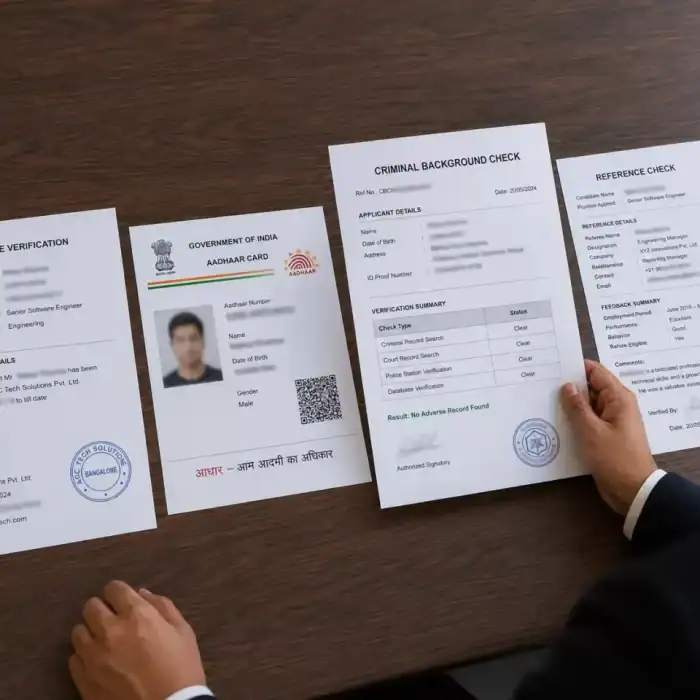
A hiring manager once shared a story that stuck with us: a candidate joined as a senior finance lead, impressed the team for three months, and then vanished the day an audit uncovered his degree was fake. The company had skipped one crucial step - a proper bgv verification.

Stories like this aren't rare. As hiring speeds up and remote applications pour in from everywhere, bgv verification has quietly become the one step companies can't afford to shortcut. Employers need to know exactly which documents to check, why each one matters, and how to build a background verification checklist that actually works.

Here's a practical breakdown of employment bgv, grouped by what each document protects you from.
Why Employers Can't Skip the Background Verification Process
Every hire carries risk, but a weak or rushed background verification process multiplies it. Whether it's a fabricated degree, an inflated job title, or a hidden financial red flag, the gaps only surface after the damage is done. This is exactly why pre-employment verification has moved from being a "nice to have" to a standard part of employment background verification across almost every industry today, and why every HR team should work from a clear background verification checklist rather than an ad-hoc process.
Category 1: Confirming the Candidate Is Who They Say They Are
- ID Proof: PAN, Aadhaar, Voter ID, Driving License, or Passport form the base of the bgv verification process. Each serves a different purpose – PAN tracks financial history, Aadhaar rules out fake identities, and passport checks flag tampering. If details don’t match across documents, that’s your first red flag.
- Address Proof: A verified residential address confirms where a candidate actually lives, and matters for offer-letter delivery, legal notices, and emergency contact. Visits to present and permanent addresses, along with neighborhood inquiries, give a far more complete picture than a self-declared address ever could.
Category 2: Confirming What They Say They've Achieved
- Educational Certificates: Degree certificates, mark sheets, and enrollment records should be cross-checked directly with the university or board, not just accepted at face value. Candidates commonly manipulate joining years, inflate marks, or fabricate technical certifications – one of the most commonly skipped checks in a rushed employment background verification cycle.
- Employment History Records: Offer letters, relieving letters, and designation proof help verify past tenure and role claims through direct contact with the previous employer. This step alone often separates a solid employment bgv from a surface-level one, and confirms the claimed employer is a genuine, operating business.
- Reference Letters and Contact Details: A phone call to a former manager, guided by open-ended questions, often reveals more than any document. It fills in the gaps around work ethic, team fit, and the real reason someone left their last role, while also surfacing red flags that don’t show up on paper. This step is a core part of any thorough employment background verification, since references validate the human side of a candidate’s history.
Fullscan - India's First AI-Powered BGV Platform
No more slow background checks. Fullscan’s AI-powered platform verifies candidates in hours, not weeks, backed by real expertise, so you hire with confidence.
Category 3: Confirming Legal and Safety Standing
- Criminal Record Documents Police verification and criminal court records protect your team, your data, and your company’s liability. Because a local police station check doesn’t always capture activity from a different jurisdiction, a broader court-record search across magistrate, district, and state courts gives a more reliable result.
Category 4: Confirming Financial Standing
- Credit Report / CIBIL Records: Not needed for every hire, but critical for finance or roles involving cash or valuable goods. A credit report reveals loan repayment history, credit utilization, and delayed payments, helping employers assess financial responsibility before granting access to sensitive systems.
- Form 16: This tax document confirms deductions and validates the salary an employee claims to have earned. Verifying Form 16 is a quick way to confirm authenticity of past employment.
- Bank Statement: Bank statements confirm financial standing and are typically verified directly with the bank branch to cross-check against the candidate’s submitted copy – an added layer of confidence for finance-related or high-trust roles.
How Digital and Physical BGV Verification Methods Compare
Not every document needs the same verification approach, and understanding the difference helps employers set realistic expectations on speed and reliability.

Digital verification: works well for ID proof, address confirmation, and document authentication. A candidate fills a mobile-based form, uploads scanned copies, and in some cases shares a photo with GPS location tagging. This contactless approach speeds up the background verification process significantly and suits high-volume hiring where turnaround time matters.

Physical verification: remains the gold standard for high-risk checks. It involves in-person visits and direct calls to issuing authorities, since scanned copies alone don't always capture the full picture. A thorough employment bgv benefits from this approach, confirming in person that a claimed employer is a genuine, operating business rather than a shell entity on paper.

Most employers get the best results by combining both: digital methods for speed on lower-risk documents like ID and address proof, and physical checks for anything tied to high-trust or high-stakes roles. This blended approach is fast becoming the standard in pre-employment verification, since it balances speed with accuracy.
The Real Cost of Skipping BGV Verification
It's tempting to speed through checks when a role needs to be filled urgently. But a single bad hire, backed by falsified documents, can cost far more in legal fees, lost productivity, and team disruption than a thorough bgv verification process ever would.

BGV verification will keep evolving as hiring becomes faster and more remote-first, but the core purpose stays the same: making sure the person you're hiring is exactly who and what they claim to be. Employers who treat pre-employment verification as a formality often pay for it later. Start with these nine documents, adapt your background verification checklist to your industry's specific risks, and you'll have a hiring process that protects your company without slowing down good candidates. That's a foundation worth protecting, one document at a time.
Let Fullscan Handle Your BGV Verification
Running all nine checks in-house takes time most HR teams don't have. Fullscan combines digital and physical verification to deliver accurate, compliance-ready background verification reports within 4 to 7 days, so you can hire with confidence. Talk to our BGV experts
FAQs
What documents are required for employment background verification?
Employers typically need ID proof, address proof, educational certificates, employment history records, reference details, and criminal record documents. For finance-related roles, credit reports, Form 16, and bank statements are also verified. What's the difference between digital and physical BGV verification?
Digital verification uses mobile forms and document uploads for faster, lower-risk checks like ID and address proof. Physical verification involves in-person visits and direct authority calls, and is used for higher-risk checks tied to high-trust roles. How much does BGV verification cost per employee?
Pricing depends on the number of checks included (ID, education, employment, criminal, credit) and typically follows a per-candidate model. Most background verification agencies offer transparent, pay-per-check pricing with no hidden costs. Is it more cost-effective to outsource BGV verification than build an internal team?
Building an internal verification team means hiring specialists, maintaining court and authority relationships, and absorbing delays. Outsourcing to a background verification agency is typically more cost-effective at scale, since the fixed per-check cost avoids the overhead of internal headcount.