
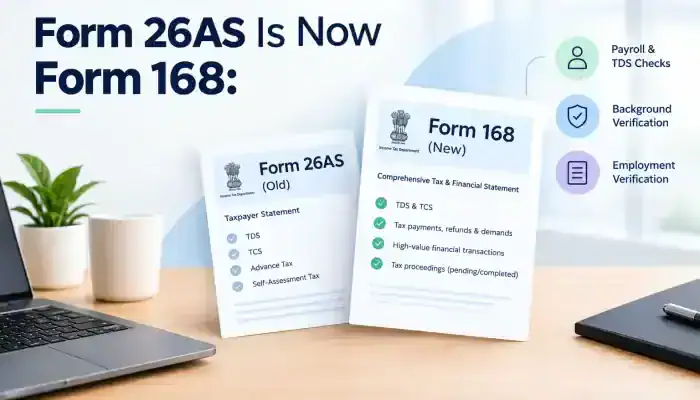
If you work in HR or payroll, you may have noticed something new this year. Candidates are sharing tax statements with a form number your team doesn't recognise, and employees are asking where their Form 26AS went.

Here's the short answer: under the new income tax rules, Form 26AS has been replaced by Form 168. But it isn't just a new name. Form 168 holds more of a person's financial information than Form 26AS did, and that changes how HR teams should use it for payroll checks and employment verification.
First, What Is Form 26AS?
Think of Form 26AS as a passbook for your taxes. It's a single statement linked to your PAN that shows the tax already paid or deducted in your name: TDS, TCS, advance tax and self-assessment tax.

To access it, most people use the "income tax login 26AS" route: sign in to the income tax e-filing portal, open e-File, go to Income Tax Returns, and click View Form 26AS. Employees use it to confirm that their employer deposited the tax deducted from their salary. Employers and verification teams have long used it as supporting proof of past employment.
So What Is Form 168?
The Income-tax Act, 2025 came into force on 1 April 2026, and the Income-tax Rules, 2026 renumbered many familiar forms along with it. Under these rules, Form 168 replaces Form 26AS, and also takes over the role of the Annual Information Statement (AIS).
That makes Form 168 a broader statement. Along with TDS and TCS, it can include:
Tax payments, refunds and demandsHigh-value financial transactions reported by banks, mutual funds and registrarsDetails of tax proceedings, pending or completed
The Income Tax Department generates Form 168 from these sources and updates it as new information is processed. Taxpayers don't file it themselves.One language change is also worth knowing: "assessment year" and "previous year" have been merged into a single term, "tax year."Which Form Applies Right Now?
Both names are in circulation, which is why people are confused. What decides the form is the year the income belongs to, not the date the document is downloaded.| Income earned in | Statement |
|---|---|
| FY 2025-26 and earlier | Form 26AS (old rules under the 1961 Act) |
| Tax year 2026-27 onwards | Form 168 (new rules under the 2025 Act) |
So an employee changing jobs this year may share a Form 26AS for last year and a Form 168 for the current year. Both are genuine, and your team should recognise both.What Changes for Employers
How TDS works hasn't changed, but several forms HR and payroll use every day have new numbers. Three things need your attention.

1. Payroll and TDS reconciliation

Form 168 reflects the TDS you deduct and deposit, so it should match your quarterly salary TDS returns, now filed in Form 138 (formerly Form 24Q). If a PAN is wrong or a return is filed late, the employee's statement will show it. Reconcile every quarter so nothing surprises you at year-end.

2. Updated templates and declarations

Other salary-related forms were renumbered too:
| Old form | New form | Used for |
|---|---|---|
| Form 16 | Form 130 | Salary TDS certificate issued to employees |
| Form 12BB | Form 124 | Employee declarations for HRA, LTA, home loan interest and tax-saving investments |
| Form 24Q | Form 138 | Quarterly salary TDS return |
| Form 26AS and AIS | Form 168 | Annual tax and financial information statement |
Check that your payroll software, declaration forms and onboarding document lists use the new numbers.Want to know more about Form 16 Verification Read It Here!
Employee questions
Expect messages like "Where did my Form 26AS go?" or "Why is my Form 16 called Form 130?" A short FAQ on your HR portal will save your team many repeat emails.Want to verify tax statments of your employees
FullScan confirms past employment through UAN, Form 130 and direct employer checks, with an interim report in 6 hours.
Why Background Verification Teams Should Care
This is the part many companies miss. Employment verification often relies on tax documents as proof of a candidate's past jobs. A salary TDS certificate and an annual tax statement can show that a previous employer actually paid the person and deducted TDS under a valid TAN.With new form numbers in circulation, verification checklists need a small update. Otherwise, a genuine Form 168 or Form 130 might be rejected simply because the name looks unfamiliar. That delays hiring and frustrates good candidates for no reason.Make sure your onboarding team and your verification partner accept both the old and new form names.Employment Verification: Look at the Details, Not the Label
Employment verification is about confirming that someone actually worked where they say they did. When you review a Form 168, Form 26AS or Form 130, focus on what's inside:Employer name and TAN: do they match the company on the resume?Period: does the tax year cover the employment dates claimed?TDS amount: does it roughly fit the salary the candidate mentioned?Source: is the document downloaded directly from the income tax portal, not a screenshot or an edited PDF?
If a previous employer's TDS doesn't show up, don't jump to conclusions. Sometimes the old company simply filed late. Ask the candidate to check with them before you flag anything.Tax documents are useful, but they work best alongside other sources. UAN and EPFO records can confirm joining and exit dates, and direct employer checks confirm designation and conduct.
Ask Only for What You Need
Because Form 168 now carries more than tax deductions, collecting the full statement from a candidate can mean collecting their bank, investment and property transaction details too. None of that is needed to verify employment.Under the Digital Personal Data Protection (DPDP) Act, 2023, organisations should collect only the personal data needed for a stated purpose. For employment verification, that usually means:
Asking for the TDS section that shows the employer's name and TAN, not the full statementUsing the salary TDS certificate (Form 130) where it is enoughConfirming dates through UAN and EPFO records insteadCollecting consent first, sharing the document only with the people who need it, and storing it securely
Make sure your verification partner follows the same standards.Quick Checklist for HR and Payroll Teams
Update payroll software and templates for the new form numbers (130, 124, 138, 168)Accept both Form 26AS and Form 168 in onboarding and verificationAsk candidates only for the sections of Form 168 you actually needRefresh onboarding emails and document listsPublish a short employee FAQ on the new form namesReconcile TDS deposits against filed returns every quarterTrain recruiters to check the details, not just the form name
Final Thoughts
The move from Form 26AS to Form 168 doesn't change how tax credits work, but it does change what's inside the statement and how HR should handle it. Update your forms and checklists, accept both names, and ask candidates only for what you need.

Rules can still be refined, so keep an eye on the official income tax portal for the latest updates.

Need employment verification that works whatever form a candidate shares? Get an interim report within 6 hours, and pay nothing if we miss our turnaround time.
FAQs
What is the difference between Form 26AS and Form 168?
Form 26AS primarily shows tax credits and related tax details, while Form 168 is described as covering a wider range of financial information, including specified transactions and tax proceedings. What is the new name for Form 16?
Form 16, the salary TDS certificate, is now Form 130 under the new rules. Can Form 168 be used for employment verification?
Yes. The employer name, TAN and TDS entries can help confirm past employment. Ask only for the relevant section, and use it alongside UAN and employer checks. Where can I download Form 26AS or Form 168?
Both are available through the income tax e-filing portal after logging in with your PAN.