
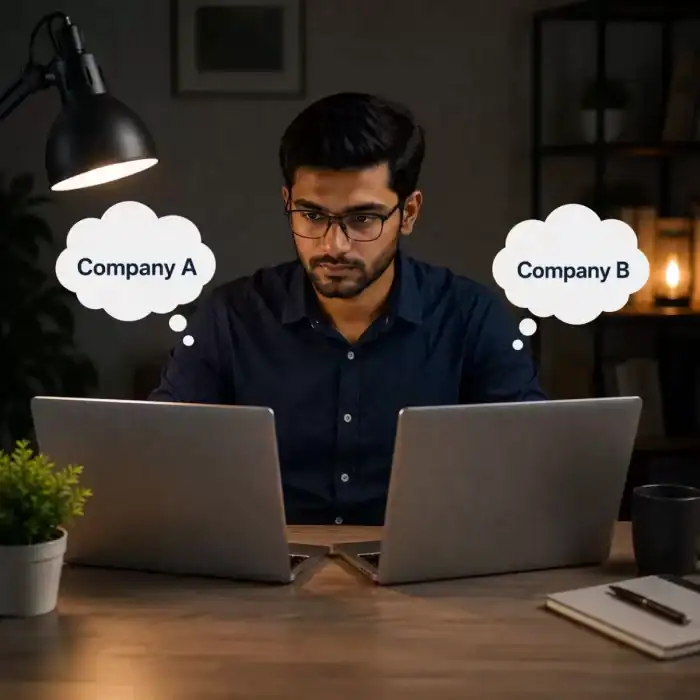
Prime Minister Narendra Modi just asked India to work from home.
For employees across the country, that felt like great news. No commute, no fuel costs, and more flexibility. But for HR teams, this has immediately brought back conversations around Dual Employment Verification, moonlighting, and employee fraud risks.
Many IT Companies and large enterprises are already evaluating what this means for their operations, because this time the reason is serious. India imports over 85% of its fuel and the ongoing global supply disruption is putting enormous pressure on energy costs across the country.
But inside every HR department , a different conversation is happening.
Because the last time India went remote, HR teams did not just deal with productivity and connectivity issues. They dealt with something far more damaging and far harder to catch.
For employees across the country, that felt like great news. No commute, no fuel costs, and more flexibility. But for HR teams, this has immediately brought back conversations around Dual Employment Verification, moonlighting, and employee fraud risks.
Many IT Companies and large enterprises are already evaluating what this means for their operations, because this time the reason is serious. India imports over 85% of its fuel and the ongoing global supply disruption is putting enormous pressure on energy costs across the country.
But inside every HR department , a different conversation is happening.
Because the last time India went remote, HR teams did not just deal with productivity and connectivity issues. They dealt with something far more damaging and far harder to catch.
WFH Is Back. And the Moonlighting Problem Might Be Back With It.
Cast your mind back to 2020. Offices shut overnight. Employees went home with their laptops and a promise to stay productive.
What followed was one of the biggest trust crises Indian IT had ever seen.
Wipro fired 300 employees after discovering they were working for competitors while still on their payroll. One employee at a major IT firm was found working for seven companies simultaneously, caught only because a sharp HR manager noticed multiple active UANs in their EPFO records. TCS, HCL, Infosys and other IT firms rushed to rewrite employment contracts overnight.
What started as a quiet side hustle had turned into a full-blown business risk that nobody saw coming.
Companies spent the next two years pushing employees back into offices just to regain control. Most IT firms settled on a three-day hybrid model by 2023. TCS quoted “It took 18 months of hard effort to bring office attendance back to pre-pandemic levels.”
And now overnight WFH is back.
The fuel crisis brought it back. The question every HR head should be asking right now is simple: Will moonlighting return with the new WFH wave?
What followed was one of the biggest trust crises Indian IT had ever seen.
What started as a quiet side hustle had turned into a full-blown business risk that nobody saw coming.
Companies spent the next two years pushing employees back into offices just to regain control. Most IT firms settled on a three-day hybrid model by 2023. TCS quoted “It took 18 months of hard effort to bring office attendance back to pre-pandemic levels.”
And now overnight WFH is back.
The fuel crisis brought it back. The question every HR head should be asking right now is simple: Will moonlighting return with the new WFH wave?
What Is Moonlighting and Why Is It Called That?
The term moonlighting comes from the idea of working by moonlight taking on extra work after the sun goes down, after your primary employer thinks you have logged off for the day.
In the 1950s and 60s, it referred to factory workers who took second jobs at night to make ends meet. Nobody considered it a corporate risk back then because physical presence made dual employment nearly impossible to hide for long.
But in 2024 India where work happens on a laptop, from a bedroom, with no one watching moonlighting looks very different.
Today it shows up in three ways that each carry a different level of risk for Indian IT companies.
The first is concurrent full-time employment where an employee draws two full salaries from two different companies at the same time, fully undetected because both jobs are remote.
The second is competitor employment where an employee works for a direct competitor, creating a data security risk, a conflict of interest, and a violation of their non-compete clause all at once.
The third is undisclosed freelance or gig work where an employee takes on project-based work outside office hours. This is the hardest to detect and the most common form of moonlighting among the Indian IT sector today.
Each of these creates real financial, legal, and reputational exposure. And when your workforce goes remote, every single one of them becomes significantly harder to spot.
In the 1950s and 60s, it referred to factory workers who took second jobs at night to make ends meet. Nobody considered it a corporate risk back then because physical presence made dual employment nearly impossible to hide for long.
But in 2024 India where work happens on a laptop, from a bedroom, with no one watching moonlighting looks very different.
Today it shows up in three ways that each carry a different level of risk for Indian IT companies.
The first is concurrent full-time employment where an employee draws two full salaries from two different companies at the same time, fully undetected because both jobs are remote.
The second is competitor employment where an employee works for a direct competitor, creating a data security risk, a conflict of interest, and a violation of their non-compete clause all at once.
The third is undisclosed freelance or gig work where an employee takes on project-based work outside office hours. This is the hardest to detect and the most common form of moonlighting among the Indian IT sector today.
Each of these creates real financial, legal, and reputational exposure. And when your workforce goes remote, every single one of them becomes significantly harder to spot.
How to Detect Moonlighting in India - What HR Teams Are Missing
Most companies rely on standard onboarding checks, offer letter, ID proof, last salary slip, and a quick call to the previous employer. That process was never built to catch dual employment. It was built to confirm basic identity.
UAN verification for moonlighting: It is the most reliable detection method available to Indian employers today. Every salaried employee in India has a Universal Account Number linked to their EPFO records. When an employee works two jobs that both require PF contributions, both employers show up against the same UAN. Cross-checking a candidate’s UAN against the EPFO database reveals multiple active PF contributions as a direct signal of concurrent employment.
However, UAN verification alone is not enough. Freelance work, gig roles, and consultancy projects do not always require PF contributions which means they will never appear in EPFO records. This is where a structured pre-employment background check in India goes beyond the UAN and cross-checks employment history, employer legitimacy, and work tenure through direct verification with previous organisations.
Standard HR processes catch the obvious cases. Proper moonlighting detection in India catches everything else.
UAN verification for moonlighting: It is the most reliable detection method available to Indian employers today. Every salaried employee in India has a Universal Account Number linked to their EPFO records. When an employee works two jobs that both require PF contributions, both employers show up against the same UAN. Cross-checking a candidate’s UAN against the EPFO database reveals multiple active PF contributions as a direct signal of concurrent employment.
However, UAN verification alone is not enough. Freelance work, gig roles, and consultancy projects do not always require PF contributions which means they will never appear in EPFO records. This is where a structured pre-employment background check in India goes beyond the UAN and cross-checks employment history, employer legitimacy, and work tenure through direct verification with previous organisations.
Standard HR processes catch the obvious cases. Proper moonlighting detection in India catches everything else.
How Fullscan Runs Dual Employment Verification in India
At Fullscan, dual employment verification is not a single checkbox, it is a layered process built specifically for the gaps that standard HR checks leave open.
We start with UAN-based EPFO verification cross-checking the candidate’s Universal Account Number against active PF contribution records to identify any concurrent employment during the claimed period.
We then run full employee background verification on both the candidate and the employer. Employee verification confirms actual work tenure, job title, and employee ID directly through official contact with the previous organisation. Employer verification physically confirms the company exists, runs genuine operations, and matches what the candidate has claimed because sometimes the employer itself is fabricated to cover employment gaps.
We flag fake tenure, hidden concurrent employment, and dual PF contributions in a single audit-ready report delivered in 6 hours, 100% in-house, with zero data risk from third-party sub-vendors.
For IT companies in Hyderabad, Bengaluru, Pune, and Chennai now navigating another WFH cycle, this is not a nice-to-have. It is the only way to know for certain that the person joining your team is working exclusively for you.
We start with UAN-based EPFO verification cross-checking the candidate’s Universal Account Number against active PF contribution records to identify any concurrent employment during the claimed period.
We then run full employee background verification on both the candidate and the employer. Employee verification confirms actual work tenure, job title, and employee ID directly through official contact with the previous organisation. Employer verification physically confirms the company exists, runs genuine operations, and matches what the candidate has claimed because sometimes the employer itself is fabricated to cover employment gaps.
We flag fake tenure, hidden concurrent employment, and dual PF contributions in a single audit-ready report delivered in 6 hours, 100% in-house, with zero data risk from third-party sub-vendors.
For IT companies in Hyderabad, Bengaluru, Pune, and Chennai now navigating another WFH cycle, this is not a nice-to-have. It is the only way to know for certain that the person joining your team is working exclusively for you.
The WFH Window Is Open. Do Not Wait to Find Out the Hard Way.
WFH is already being adopted across Indian IT. The moonlighting window opened the moment Modi made that push and unlike 2020, companies this time have no excuse of being unprepared.
Every hire you make in a remote environment without proper dual employment verification is a hire you are making on trust alone. And trust without verification is not an HR policy. It is a liability.
At Fullscan, we offer complete BGV services across India covering dual employment checks, UAN verification, employment history, and criminal court records for IT companies that cannot afford to get hiring wrong.
Hire knowing the truth. Visit Fullscan and run your first dual employment check today.
Every hire you make in a remote environment without proper dual employment verification is a hire you are making on trust alone. And trust without verification is not an HR policy. It is a liability.
At Fullscan, we offer complete BGV services across India covering dual employment checks, UAN verification, employment history, and criminal court records for IT companies that cannot afford to get hiring wrong.
Hire knowing the truth. Visit Fullscan and run your first dual employment check today.
FAQs
What is dual employment verification in India?
Dual employment verification in India is the process of checking whether an employee is working for multiple companies at the same time. Companies use UAN verification, EPFO checks, and employment background verification to detect moonlighting and concurrent employment.
How do companies detect moonlighting in India?
Companies detect moonlighting in India through UAN verification, EPFO contribution checks, employment history verification, and employee background verification. Multiple active PF contributions under one UAN are a major indicator of dual employment.
Is moonlighting legal in India?
Moonlighting is not fully illegal in India, but it can violate employment contracts, non-compete clauses, confidentiality agreements, and company policies, especially in the IT sector.
Why is dual employment a risk for IT companies?
Dual employment increases risks related to data security, productivity loss, conflict of interest, confidentiality breaches, and insider threats, especially in remote work environments.