
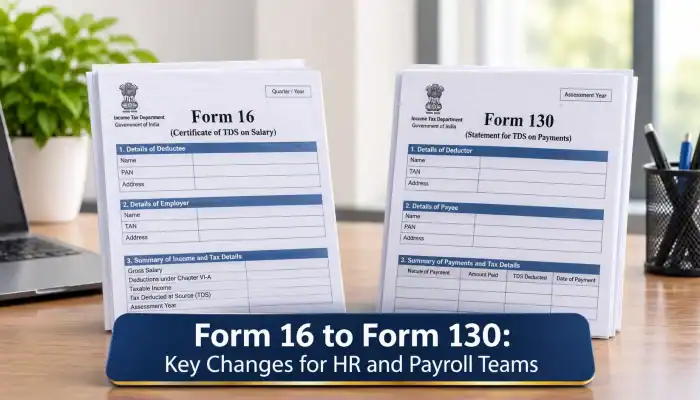
When an employee requests a salary tax certificate during exit formalities or a background check, HR may be asked to provide or review Form 16. From 1 April 2026, the salary TDS certificate under the new income-tax framework is Form 130. HR and payroll teams must update processes, employee communication and document reviews.
The form 16 to form 130 transition matters for organisations managing frequent exits and high-volume recruitment. Knowing which certificate belongs to which tax period can prevent confusion and unnecessary follow-ups.
Form 16 and Form 130: Which one applies?
Form 16 is the salary TDS certificate under the Income-tax Act, 1961. Form 130 transition is its corresponding certificate under the Income-tax Rules, 2026.
The new framework took effect on 1 April 2026. Salary paid up to 31 March 2026 remains under the earlier framework and is covered by Form 16. Salary paid from 1 April 2026 falls under the new framework and the corresponding certificate is Form 130. Both forms may therefore appear in employee records during the transition. An older Form 16 is not invalid simply because Form 130 has been introduced.
When handling form 16 to form 130 queries, check the period covered before asking an employee or former employer for another document.
What information does Form 130 contain?
Form 130 is an annual certificate recording salary-related tax deducted at source (TDS). It has three parts:
- Part A identifies the employer and employee, including PAN, tax year and employment period.
- Part B summarises amounts paid or credited and the TDS deducted and deposited.
- Part C provides the detailed tax computation, including gross salary, exemptions, deductions, taxable income and tax payable for salary cases.
Reconcile these details with payroll and TDS records, checking employee identifiers, employer details, tax period and amounts. Form 130 is generated and downloaded through the prescribed TRACES process; it should not be recreated by editing an internal payroll document.
Managing form 16 to form 130 in payroll
Use these steps to manage the change:

1. Separate records by tax period
Update payroll calendars and document checklists to distinguish FY 2025–26 from Tax Year 2026–27. This prevents incorrect document requests.

2. Align payroll and HR communication
Align payroll, finance and HR guidance. Employees leaving the organisation should know which certificate applies, when it will be available and whom to contact if details need correction.

3. Review details before issuing the certificate
Check PAN, name, employer information, employment dates and salary/TDS figures against source records. Investigate mismatches before issuing the certificate. Do not manually alter the downloaded form.

4. Plan for employees who changed jobs
An employee may have worked for more than one employer during a tax year. Under Rule 215, each employer issues Parts A and B for its own employment period. Part C may be issued by each employer or by the last employer, at the employee's option. Explain this during exit formalities so employees understand why they may receive documents from multiple organisations.

5. Protect employee information
Salary certificates contain personal financial information. Share them through approved channels, restrict access and follow retention policies.
Can Form 16 or Form 130 support employment verification?
A tax certificate can support a candidate’s declared employment history, but it does not independently confirm every detail of a job. It may show employer details, a period and salary-related information; it does not establish designation, responsibilities, reporting manager or reason for leaving.
During form 16 verification or form 130 verification, compare the document with the candidate’s declared dates and other authorised evidence, such as experience letters, relieving letters or previous-employer confirmation. Online form 16 verification should include checking the document’s consistency and source; the certificate alone is not conclusive proof of service. For form 130 verification, apply the same evidence-led approach; online form 16 verification for older periods should check the document’s source and consistency.
Each review should record what the certificate confirms, with differences referred for clarification. Do not mark a case negative solely because a certificate is unavailable or a tax period does not exactly match the employment period.
What should organisations expect from a BGV partner?
As payroll documents change, screening teams need clear guidance on which records apply to which period. Organisations using background verification services should ensure their provider understands both formats and the limits of tax documents. Good employment verification services combine document review with appropriate checks of employment details, discrepancy handling and clear reporting. When comparing employment verification services, ask how the provider handles unavailable certificates and mismatched dates.
Prepare your team for the change
The form 16 to form 130 transition requires updated payroll processes and employee guidance. Brief HR and finance teams, update checklists and use tax certificates only as supporting evidence, not as a substitute for a complete employment check.
Fullscan helps organisations manage employee screening through structured verification and reporting across India. Speak with Fullscan about a background verification aligned with your hiring requirements.
Frequently Asked Questions
What is the main difference between Form 16 and Form 130?
Form 16 was the salary TDS certificate under the earlier income-tax framework. Form 130 replaces it under the Income-tax Act, 2025, and the Income-tax Rules, 2026. Form 130 provides details of salary paid, tax deducted and the employee’s tax computation in the prescribed format.
When does Form 130 become applicable?
Form 130 applies to salary paid from 1 April 2026 under the new tax framework. Form 16 remains applicable for salary paid up to 31 March 2026. HR and payroll teams should maintain records according to the applicable tax period.
Will Form 16 become invalid after the introduction of Form 130?
No. Form 16 does not become invalid. It remains relevant for salary and TDS records relating to periods covered by the earlier framework. Form 130 applies to the new tax period beginning 1 April 2026.
Which certificate should HR provide to employees for FY 2025–26?
For FY 2025–26, employees should receive Form 16 under the earlier framework. Form 130 applies to salary paid from 1 April 2026, corresponding to Tax Year 2026–27.
What should HR do if the employment dates or salary details do not match Form 130?
HR should first identify the specific discrepancy and compare the certificate with available payroll and employment records. If the details remain inconsistent, the employee should be asked for clarification or a corrected document through the appropriate employer or payroll channel before any conclusion is reached.