
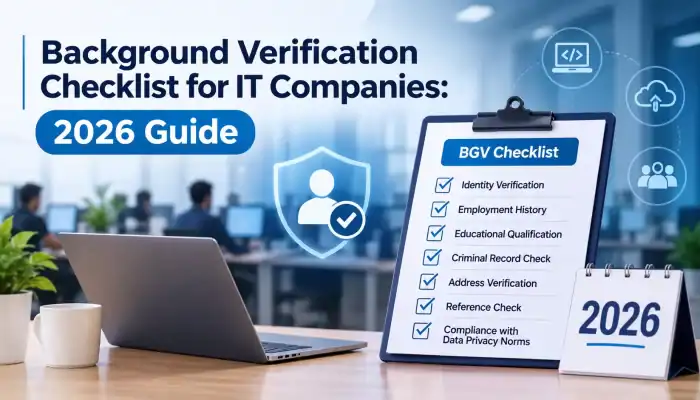
An IT company hiring a fresher, a senior software developer, a project manager and a privileged-access administrator is dealing with four different hiring requirements. Each position comes with different responsibilities, access levels and potential risks.

A fresher may require closer attention to educational qualifications, while a developer's previous employment and project experience need to be established. A project manager may require additional reference checks, and an administrator with access to critical systems may need more extensive screening.

Yet, many organisations follow the same background verification process for every candidate. This can leave important gaps in screening or result in unnecessary checks that do not add value.

For HR leaders, building an effective background verification checklist for IT means understanding what needs to be verified, which risks matter for each role and how to handle discrepancies before making a hiring decision.

Here is a practical checklist IT organisations can use to plan employee background verification in 2026.
Background Verification Checklist for Different IT Roles
Not every check needs to be applied in the same way to every employee. The verification scope should depend on the candidate's experience, job responsibilities, access to systems and client requirements.

The following employee background verification checklist provides a starting point for HR teams.
| Verification Check | Fresher | Senior Developer | Project Manager | Privileged-Access Admin |
|---|---|---|---|---|
| Identity verification | ✓ | ✓ | ✓ | ✓ |
| Education verification | ✓ | ✓ | ✓ | ✓ |
| Previous employment check | If applicable | ✓ | ✓ | ✓ |
| Form 26AS / AIS review | If applicable | ✓ | ✓ | ✓ |
| UAN / dual employment check | If applicable | ✓ | ✓ | ✓ |
| Address verification | ✓ | ✓ | ✓ | ✓ |
| Criminal / court record check | As relevant | As relevant | As relevant | ✓ |
| Professional reference check | If applicable | ✓ | ✓ | ✓ |
| Global database screening | If required | If required | If required | Based on access and client requirements |
Note: This is a role-based reference checklist, not a list of mandatory checks for every employee. HR teams should determine the final screening scope based on job responsibilities, applicable laws, candidate consent, client requirements and organisational policy.Start with the Role, Not the Verification Documents
One common mistake in IT hiring is treating background verification as a standard administrative exercise. The screening process should begin with the responsibilities of the position.For example:
Fresh graduates: Focus on identity, educational qualifications, internships and any employment experience they have declared.Senior Software developers: Verify identity, education, previous employment and relevant project experience, particularly where candidates claim specialised technical responsibilities.Project managers: Pay attention to employment history, previous designations, experience, professional references and leadership responsibilities.Privileged-access administrators: Consider additional checks appropriate to their access to infrastructure, sensitive information, critical systems and security controls.
This role-based approach helps HR teams create a relevant screening scope instead of applying an identical process to every candidate.Five Core Areas HR Teams Should Verify
1. Does the Candidate's Employment History Match Their Claims?
Employment history is particularly important in IT recruitment, where candidates may have worked across multiple organisations, projects and employment arrangements.

An employment check should establish previous employer details, job titles and employment dates. HR teams should also review relevant experience letters, relieving letters and other supporting records.
Pay attention to:Unexplained gaps or overlapping employment periods.Differences in joining and relieving dates.Designations that do not match the candidate's declaration.Previous employers whose business identity or operations cannot be independently established.Experience letters or payslips that cannot be confirmed through an appropriate source.
Fake IT companies issuing experience letters are another risk. A candidate may submit documents from an organisation that has a website, address or professional-looking communication but whose actual business operations are difficult to establish.

In such cases, checking the document alone is not sufficient. The verification process should examine the employer's business identity, available registration details, operating presence and the source confirming the candidate's employment.

2. Check for Dual Employment and Moonlighting
Dual employment and moonlighting are important concerns for IT companies, particularly when employees work remotely or across multiple client projects.
A candidate may declare one full-time employer while their employment records indicate another organisation during the same period. In some cases, an employee may also take up additional work after joining without informing their employer.One useful source for reviewing employment history is the candidate's UAN (Universal Account Number) service history.Where the candidate provides appropriate consent and the records are available, HR teams can examine:Previous establishments linked to the UAN.Date of joining and date of exit recorded for each establishment.Employment periods that appear to overlap.Multiple PF contributions during overlapping periods, where visible in the available records.
An overlap should not automatically be treated as proof of moonlighting or misconduct. Delayed exit updates, record corrections, transfers and other administrative reasons can also create apparent inconsistencies. The candidate should be given an opportunity to clarify the records before a conclusion is reached.
Re-verification after joining: For roles or employment arrangements where the organisation has a legitimate requirement, HR teams can also establish a defined process for reviewing relevant employment disclosures after joining. This should be communicated transparently, follow applicable policies and obtain any required consent.The objective is to identify unexplained employment overlaps and assess them fairly, not to assume that every additional record indicates unauthorised employment.
3. Are Qualifications and Professional Credentials Genuine?
Technical hiring often involves specific educational qualifications, certifications and specialised training.
A candidate may mention a degree, postgraduate qualification or industry certification as evidence of their suitability. HR teams should validate these claims through appropriate educational institutions or authorised verification channels.For roles where a particular qualification is essential, this check becomes especially important.For example, if a developer is hired based on a specific technical qualification or a project manager claims a relevant professional certification, the organisation should establish whether those credentials are genuine.A discrepancy should be investigated before the organisation relies on that qualification during its hiring decision.
4. Can Form 26AS and AIS Support Employment Verification?
In Indian IT hiring, tax-related records can provide additional information when reviewing a candidate's declared employment history.
Two records HR teams may consider, where appropriate and voluntarily provided by the candidate, are:
Form 26AS: This statement primarily contains Tax Deducted at Source (TDS) and Tax Collected at Source (TCS) information. Salary-related TDS entries may help identify the deductor associated with reported income.
Annual Information Statement (AIS): AIS provides a wider view of information reported to the Income Tax Department, including TDS/TCS information and other reported financial transactions. It may offer additional context when reviewing income-related declarations.These records can help HR teams identify information that needs clarification. For example, a reported deductor may differ from the employer declared by the candidate.However, Form 26AS and AIS should not be treated as complete employment histories or standalone proof that a person worked for a particular organisation. They should be reviewed alongside employment documents, employer confirmation and other appropriate verification evidence.
5. Are Identity, Address and Criminal Records Properly Verified?
Identity verification establishes whether the candidate's submitted details correspond with appropriate identity records.
Address verification helps establish the candidate's declared residential details through suitable verification methods.IT organisations working with financial institutions, healthcare companies, government projects and businesses handling confidential information may also require criminal and court record checks, depending on the role and applicable requirements.HR teams should ensure that:Identity details are matched using appropriate records.Address information is checked through suitable verification methods.Criminal and court record findings are accurately matched to the individual.Any potential match is reviewed in context.Name variations or outdated information are clarified before reaching a decision.
A name match alone should never be treated as conclusive evidence.Other IT-Specific Hiring Risks HR Teams Should Not Overlook
Apart from conventional employment and identity checks, IT companies face hiring risks connected to remote recruitment, client projects and access to business-critical systems.
Proxy Interviews in Remote Hiring
Remote interviews have made recruitment more flexible, but they can also create opportunities for candidate impersonation.In a proxy interview, someone other than the actual applicant may attend the interview, complete a technical assessment or answer questions on the candidate's behalf.The person who clears the interview may not be the person who eventually joins the organisation.To reduce this risk, HR and recruitment teams should:Follow consistent identity confirmation procedures during interview rounds.Compare the interview participant's identity with the candidate's submitted details.Conduct appropriate identity confirmation during onboarding.Ensure the person joining is the same individual who was interviewed and selected.
Identity verification should be consistent across the recruitment and onboarding stages, especially for remote technical positions.
Fake IT Companies and Employment Documents
Some candidates may submit experience letters, relieving letters or payslips from organisations that are difficult to verify.The company may have limited online information, an unclear operating address or no independently confirmable HR contact.In such situations, HR teams should not rely only on the documents submitted by the candidate.The verification process should establish whether the previous employer can be independently identified, whether the business operated during the claimed employment period and whether an appropriate source can confirm the candidate's employment.
Client-Mandated Background Verification
Many IT companies provide employees to overseas clients or work on projects involving sensitive business information, financial systems and critical infrastructure.Some US and European clients make employee background verification a contractual or project requirement. The exact checks depend on the client agreement, industry, project responsibilities and applicable regulations.For IT service providers, this means BGV is not always just an internal HR requirement. An incomplete or delayed verification may also affect project onboarding, client access approval or resource deployment.HR teams should therefore understand client-specific screening requirements before assigning employees to projects.How Should HR Teams Handle Discrepancies in BGV Reports?
A background verification report does not always come back completely clear. Sometimes, the information provided by a candidate differs from the records available through verification sources.The way HR handles these situations matters.Consider a candidate who declares three years of employment with a previous organisation, but the available records indicate a different joining date.Rather than rejecting the candidate immediately, HR should:Identify the exact information that does not match.Request supporting documents or an explanation from the candidate.Review the available verification evidence.Record the clarification and final assessment.Escalate unresolved or material discrepancies according to company policy.
Similarly, if a previous employer does not respond, the result should be recorded as pending or unable to verify, rather than automatically classified as negative.A difference between two records, an unanswered verification request and evidence that contradicts a candidate's claim are three different situations. Each requires an appropriate review.This distinction helps organisations make informed hiring decisions while maintaining a fair and consistent screening process.What Should IT Companies Expect from a Background Verification Company?
Managing BGV internally can become challenging when organisations handle multiple hiring locations, large recruitment volumes and tight onboarding schedules.Choosing the right background verification company can help HR teams manage the process more efficiently.Before selecting a provider, consider:Verification coverage: Can the provider support identity, education, employment, address and other relevant checks across India?IT hiring experience: Does the provider understand employment overlaps, fake IT employers, remote hiring risks and client-specific requirements?Turnaround time: Can it provide timely updates without compromising verification quality?Technology and reporting: Does it use technology to improve verification workflows, tracking and reporting?Discrepancy management: Does it clearly explain mismatches, pending cases and escalation requirements?Data protection: Are candidate information, consent and access controls handled appropriately?Scalability: Can it manage changing hiring volumes and multiple locations?
A reliable provider should give HR teams transparent reports that clearly show what was verified, what remains unresolved and where further clarification is required.Make Background Verification Part of Your IT Hiring Strategy
Background verification should not become the final administrative task before an employee joins. It should be an integral part of an organisation's hiring risk management process.For IT companies, a well-planned employee background verification process helps establish candidate information, identify discrepancies and support better hiring decisions. It also gives HR teams a consistent approach to screening employees across different roles, locations and client projects.At Fullscan, we help organisations manage AI-powered employee background verification across India, with verification coverage across 22,000+ pincodes. Our process combines technology-led verification with structured reporting, including interim reports within 6 hours and typical BGV turnaround times of 4–7 days.
Our employee verification services cover employment, education, identity, address and other relevant checks to help organisations assess the information provided by candidates.Whether you are hiring fresh graduates, experienced developers, project managers or senior technology administrators, Fullscan helps your HR team approach background verification with greater visibility and confidence.Connect with Fullscan to discuss background verification services aligned with your IT hiring requirements.
Frequently Asked Questions
What background checks should IT companies conduct before onboarding a software developer?
IT companies should generally verify a developer's identity, educational qualifications, previous employment, residential address and professional references. Depending on the position, access requirements and client expectations, criminal and court record checks, UAN history and relevant tax records may also be considered. The screening scope should reflect the responsibilities of the role.
How can HR teams identify fake employment history in IT resumes?
HR teams can compare the candidate's declared employment dates, designations and previous employers against independently verified records. Supporting documents, appropriately authorised UAN-linked employment information and confirmation from previous employers can help identify inconsistencies. HR teams should also establish whether the previous employer actually operated during the claimed employment period. Any mismatch should be investigated with the candidate before reaching a decision.
How can IT companies check for dual employment and moonlighting?
IT companies can review available UAN service history and PF contribution records, where appropriate and authorised, to identify possible overlapping employment periods. However, overlapping records are not automatic proof of moonlighting. HR teams should examine the dates, seek candidate clarification and consider administrative explanations before making a decision.
How can IT companies prevent proxy interviews in remote hiring?
IT companies can follow consistent identity confirmation procedures during interviews and onboarding. They should ensure that the person attending the interview is the same candidate whose identity documents are submitted and who eventually joins the organisation. Appropriate identity checks at different recruitment stages can help reduce impersonation risks.