
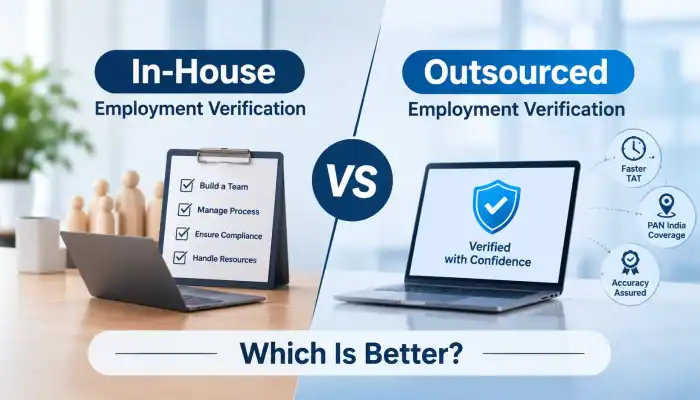
If you work in HR, you’ve probably waited on one pending verification before moving ahead with onboarding. The offer is accepted, the joining date is close, and everything is held up by that one check. After facing this situation a few times, it is natural to wonder, "Maybe we should have our own in-house BGV team."
But let’s have a look at how Employee verification services really works, and whether an in-house team or an outsourced provider is the better fit for your hiring.
What Is In-House Employment Verification?
In-house verification means your own HR team does the verification of every document and details. They call or email the old employers, collect papers like experience letters, relieving letters and payslips, and confirm the job title, joining date and last working day.Advantages of in-house verification
You stay in control. You will be deciding how the check is done and how quickly it has to be done.No other background verification company is involved. Candidate details stay inside your organisation.Easy to onboard, with no vendor delays.
Disadvantages of in-house verification
It eats up HR time. Calls, emails, and reminders add up fast, especially when old employers reply slowly.Results can vary. Two people in the same team may check in two different ways and will give results differently.Fake documents are simple to miss. Spotting a fake experience letter needs practice and the right tools.The rules are on you. Candidate consent, safe records, and data privacy according to the DPDP Act and other government rules should be taken care of by you.And the in-house project might work for 10 hires a month, but it often breaks when the hiring count increases.
What is Outsourcing of Employment Verification Services?
Outsourced employment verification services mean a specialist company handles the verification of employment for you. They contact the old employers, check databases, verify the documents and share updates with you through a dashboard or an API, so you can see the status of every candidate.
Advantages of outsourcing
Turnaround Time is Faster, as there will be a dedicated team to work on verifying all the details of the employee. It reduces the waiting time and makes the work of HR easy.Ease of Scalability: when hiring in high volume, such as campus drives or walk-ins and bulk hiring, it is handled without stretching HR.Better fraud detection. Providers see patterns across thousands of checks and are more likely to spot fake employers and forged documents rather than in-house teams.Compliance support. Consent capture, audit trails and secure data handling are built into the workflow.Predictable reporting. Clear status updates, discrepancy reports and turnaround time (TAT) tracking.
Disadvantages of outsourcing
The quality of the background verification services might vary from provider to provider. A weak vendor might have a slow turnaround time, and the report quality might differ.
Less direct control. You depend on the provider's process and communication.Data-sharing considerations. You must confirm how candidate data is stored and protected according to the DPDP Act.
Quick Comparison: In-House vs. Outsourced
| Factor | In-House | Outsourced |
|---|---|---|
| Cost per check | Appears lower, but staff time and operational costs add up | Fixed or per-check pricing makes costs easier to plan |
| Turnaround time | Depends on HR team's availability and resources | Dedicated verification teams help manage checks within defined TATs |
| Scalability | Requires additional resources during hiring spikes | Can accommodate changing hiring volumes |
| Compliance and consent | HR must establish and maintain compliant processes | Providers follow defined consent and verification workflows, with responsibilities shared by the organisation |
| Accuracy and fraud detection | Depends on internal expertise and available verification sources | Trained verification teams and independent sources help identify discrepancies |
| Control over the process | Direct control over the verification process | Shared control through provider workflows, reports and agreed service levels |
| Best for | Organisations with low hiring volumes, simple verification needs and dedicated internal resources | Organisations with medium to high hiring volumes, multiple locations or complex verification requirements |
Which Model Fits Which Business?
In-house may be enough if:
You hire fewer than a handful of people a monthRoles are junior and low riskCandidates mostly come from large, well-known employers that respond quicklyYour HR team has spare capacity
Outsourcing is usually better if:
You hire in huge volume (IT, BPO, BFSI, healthcare, staffing)You hire across cities or countriesYou work in a regulated industry where checks must be documentedTurnaround time directly affects your onboardingYou have faced fake experience letters or inconsistent checks before
Common Mistakes to Avoid
Treating in-house as free. Staff time and delays are real costs.Choosing a vendor on price alone. The cheapest provider is often the slowest or shallowest.Starting the pre-employment background check after the candidate joins. Begin at the offer stage, so a pending check does not hold up onboarding.
Skipping consent. It creates legal and trust problems.Not reviewing results. Outsourcing does not remove your responsibility for the hiring decision.
Final Conclusion
It all comes down to how many people you hire.
If your hiring volume is big, always choose outsourcing. When you are onboarding dozens or hundreds of people, chasing every employer yourself is slow, tiring and risky. A specialist provider gives you faster turnaround, steady quality, better fraud checks and clear reports, so your HR team can focus on people instead of paperwork.
If your hiring is small, in-house can work just fine. With a few hires a month, mostly junior roles and candidates from companies that reply quickly, your team can handle it without extra cost.
A simple way to decide: if your team spends more time chasing employers than talking to candidates, it is time to outsource. And if you are in between, a mix can also work, if you are specifically hiring a candidate for a project that needs to undergo bgv you can simply outsource it to the best bgv company.
Need Reliable Employment Verification Services?
If you are comparing options, talk to our team about turnaround times, pricing and coverage for your hiring volume, or download our verification checklist to review your current process.
Is in-house or outsourced employment verification cheaper?
In-house looks cheaper because there is no vendor fee, but once you add HR hours and the cost of delays, outsourcing is often more economical at scale
Can small companies use employment verification services?
Yes. Many providers offer per-check pricing, so even a startup can outsource each employment check without a large commitment.
How long does outsourced employment verification take?
It depends on the method. Database checks can take hours, while direct employer confirmation usually takes several working days. But with fullscan you can get an interim verification report within 6 hours and complete report within 7 to 14 days.
Do I need candidate consent for employment verification?
Yes. Always collect written consent before contacting previous employers or processing personal data.